
Loading...

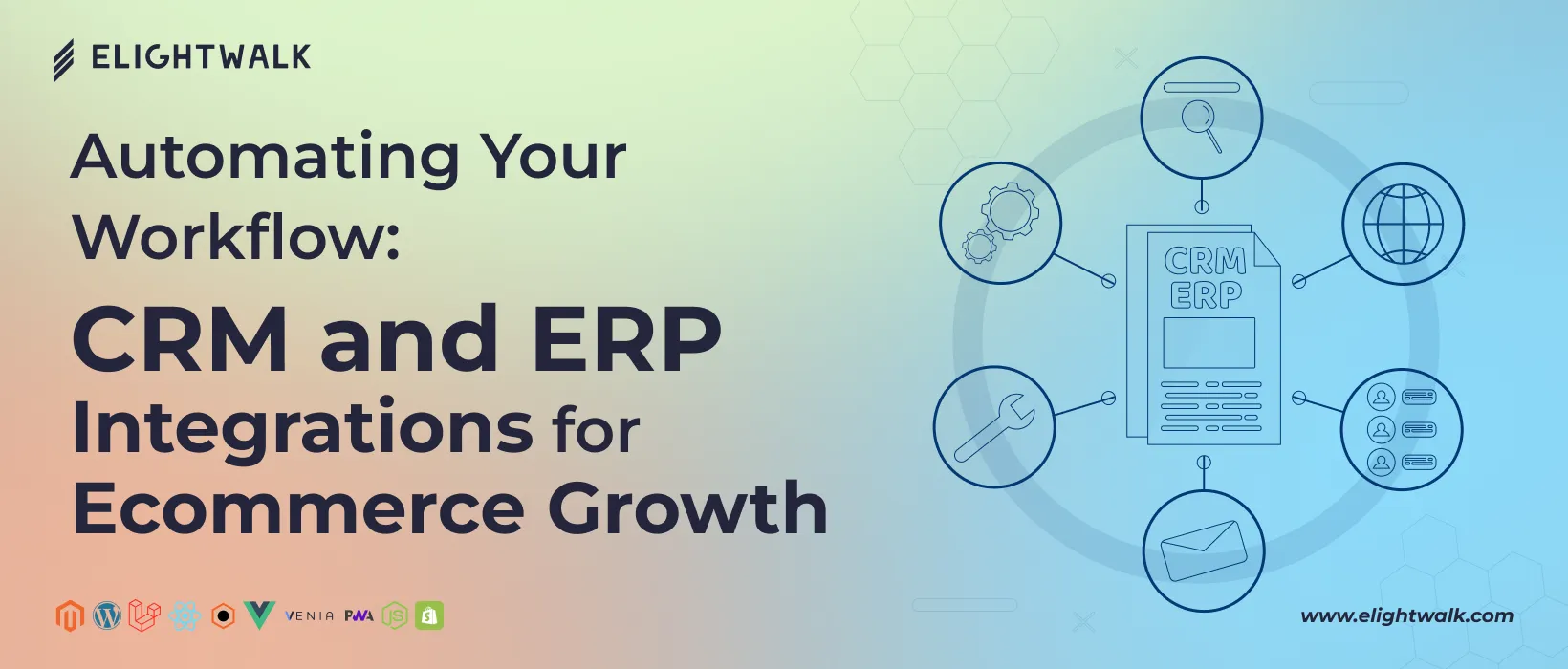
Automating Your Workflow: CRM and ERP Integrations for Ecommerce Growth

7 Mins
Jayram Prajapati  ·   20 Aug 2025
Automating Your Workflow: Boost E-commerce Growth with CRM and ERP Integrations
service-banner

Running an online store business nowadays is quite challenging. Manual handling of product inventory, customer orders, interactions, and sales tracking can quickly become a nightmare due to the numerous moving parts involved. Errors made by humans, slow communication, and data inconsistencies across platforms are the causes of inefficiencies that restrict business growth and frustrate both business owners and customers.

This is the point where an automation solution comes to help as a game-changer. Automating an e-commerce business enables the business to operate with greater speed, accuracy, and efficiency by reducing the number of repetitive tasks and centralizing the most critical processes. It doesn't matter if the work is to be done by automation to keep the inventory updated in real-time, to send out personalized follow-ups to customers, or to generate sales reports; in all cases, it is the automation that helps the brands to grow without their manual operations dragging them down.

CRM (Customer Relationship Management) and ERP (Enterprise Resource Planning) integrations are among the most impactful instruments to realize this goal. These two systems, when interconnected, establish a single workflow that streamlines management tasks, enhances customer experiences, and thus increases e-commerce. The exact process of the increase will be the topic of this blog.

What Are CRM and ERP Systems?

It is crucial to deconstruct CRM and ERP, two fundamental systems, to fathom the e-commerce power of automation. A Customer Relationship Management (CRM) tool is designed to help companies manage communication with their current and potential clients. Information such as contacts, purchasing habits, communication logs, and customer preferences is stored.

A CRM is the lifeblood of an e-commerce business, allowing for the creation of more powerful bonds through personalized marketing campaigns, customized product recommendations, and practical customer support. Simply put, CRM is centered on increasing customer engagement, satisfaction, and retention. Enterprise Resource Planning (ERP) software is a tool that manages the central part of business operations. It is a centralized system that integrates core processes, including inventory management, order fulfillment, accounting, human resources, and supply chain management.

For an e-commerce store, ERP is the source of order processing without any issues, as well as financial tracking and other related tasks. ERP facilitates businesses in their operations, making them more resourceful and cost-effective. Together, CRM and ERP can create an integrated and efficient workflow. Integration allows the seamless flow of information between different departments, as customer data is in one system and operational data in another.

Besides reducing errors and duplication, this also provides a complete up-to-the-minute business overview. With CRM and ERP integration, e-commerce brands have the advantage of delivering superior customer experiences while operating at peak efficiency.

Why Ecommerce Businesses Need Workflow Automation

E-commerce businesses operate in a fast-paced environment of business operations, where execution speed, accuracy, and customer satisfaction are the core values. On the other hand, when these operations are managed manually, only a limited number of advantages can be achieved. Inventory mistakes often lead to overselling or stock shortages, resulting in customer dissatisfaction and a decrease in revenue. Moreover, order processing delays not only impede fulfillment but also lower the chances for customers to order again. At the same time, the issue of distributed customer data residing in spreadsheets, emails, and various platforms makes it difficult to provide personalized experiences or ensure regular communication.

Workflow automation, therefore, is the solution to such problems. By integrating the CRM and ERP systems, which communicate with each other, an e-commerce business can significantly reduce the number of manual tasks and eliminate inefficiencies. Through automation, for instance, stock levels will accurately reflect reality across all sales channels, eliminating time lost in order processing and ensuring customer details are captured correctly. The result is that employees are less burdened with tedious paperwork, allowing them to dedicate more working hours to marketing and business development.

We can witness these significant advantages from this kind of implementation in the following manner: time-saving, error avoidance, and above all, customer experience enhancement. Customers are appropriately attended to with fast deliveries and receive calls at the right time when they need it, and most importantly, the so-called "personalized engagement" that directly impacts loyalty and revenue growth is provided.

Based on a survey conducted by Salesforce, 67% of automated e-commerce companies reported significant improvement in order accuracy and the speed of processing. Furthermore, research from Statista indicates that the introduction of ERP systems has enabled a reduction in operational costs of up to 23%. Consequently, the majority of companies are moving towards an automated future to stay competitive. The statistics mentioned above represent the reality of today's digital marketplace, where competition is stiff. Trading companies that are unwilling to automate their e-commerce businesses will find themselves at a disadvantage compared to those that are smart enough to opt for automated workflows.

How CRM and ERP Integrations Work

The fundamental workflow automation that integrates CRM and ERP systems is the core of the discussion. Such system admin integrations maintain the structure that allows customer-facing and back-office activities to communicate smoothly. Hence, the need for organizational silos as well as duplication becomes eliminated.

Technically, there are several ways to establish a connection between CRM and ERP systems:

  • API Connections: Most software provides room for real-time data exchange through APIs (Application Programming Interfaces) that are established between systems. For example, the system used for order capturing in an online store can simultaneously update both the CRM and ERP automatically, eliminating the need for human intervention.
  • No-Code/Low-Code Platforms: Applications like Zapier, Make, or Workato provide companies with the opportunity to connect software without the tedious process of coding; therefore, setting up a smaller integration for an e-commerce brand becomes accessible.
  • Built-In Integrations: Certain CRMs and ERPs already have pre-installed connectors; therefore, linking systems is simply a matter of a few clicks.

One of the best ways to understand is a real-life example. Let's suppose you handle an e-commerce store on either Shopify or Webflow. By aligning it with a CRM like HubSpot or Salesforce, the customer's data (including purchase history, preferences, and communication records) is directly entered into the system.

A connection with an ERP like NetSuite or Odoo ensures that stock levels, order processing, and financial data are updated in real-time. The outcome? Departments in a single, unified system where they can access accurate and up-to-date information without delay.

Such methodology brings about enormous advantages:

  • A combined dashboard that brings together sales, inventory, and customer data.
  • Updates are done in real-time across all platforms, minimizing the possibility of errors and delays.
  • Order and customer management has been simplified, leading to quicker fulfillment and better customer experiences.

The integration of CRM and ERP is like a magic wand that transforms disconnected processes into a unified system, enabling online businesses to expand their operations effectively and securely.

Integrating CRM and ERP systems not only streamlines operations but is also an excellent option that has a significant impact on the growth of e-commerce businesses. By syncing customer-facing front-end engagement with back-end operations, companies/makers can have a more efficient and clever workflow that supports both productivity and scalability.

Key Benefits for Ecommerce Growth

Integrating CRM and ERP systems doesn't just simplify operations; it unlocks a wide range of benefits that directly fuel e-commerce growth. By connecting front-end customer interactions with back-end operations, businesses can create a more streamlined and intelligent workflow that supports both efficiency and scalability.

1. Increased Efficiency

One of the most immediate advantages is improved efficiency. With automation implemented, processes such as order processing, inventory tracking, and invoicing can be executed promptly. As a result, errors that occur due to manual entry are minimized, and the fulfillment of orders is also accelerated. Thus, for e-commerce businesses, this means shorter processing times, fewer customer complaints, and smoother day-to-day operations.

2. Enhanced Customer Experience

Today's customers want to be served quickly, updated on time, and engaged in a personalized manner. CRM integrations enable companies to analyze customer behavior and purchasing history, which in turn leads to the creation of more customized marketing campaigns and the provision of better support. ERP systems play a crucial role in ensuring that stock levels and shipping timelines are always accurate, allowing customers to receive their orders on time. Altogether, these tools make it easy to earn the trust and loyalty of customers, which, in turn, constitute the basis of repeat business.

3. Data-Driven Decisions

The harmony of CRM and ERP relays crucial information to companies about sales fluctuations, customer preferences, and the sources of operational constraints. Businesses can utilize this information for predictive analytics, such as forecasting demand and identifying top-tier customers. Instead of groping in the dark, e-commerce leaders can take wiser, data-supported actions that lead to growth.

4. Scalability

The most significant advantage may be its scalability. The number of orders, customer data, and inventory will increase exponentially as your e-commerce store grows larger. Scaling without automation, however, is complicated, requiring more staff and additional management. Nevertheless, with the help of the two systems, your business can flourish effortlessly as you handle the increased capacity without substantially increasing manual workload or costs.

The integration of CRM and ERP technologies not only addresses workplace difficulties but also equips e-commerce businesses for their future, fostering sustainable growth and a green operational lifecycle.

Best Practices for Successful Integration

While customer relationship and enterprise resource planning software, along with their integrations, are capable of revolutionizing the operations of online businesses, the accomplishment of such results is contingent upon the satisfactory following of the right approach. Implementing best practices would enable enterprises to avoid the most frequent errors that lead to significant losses and subsequently maximize their return on investment.

1. Selecting a Suitable CRM and ERP

While some systems are better than others, they are, in fact, not suitable for every business. Small to mid-sized e-commerce stores may discover that products like HubSpot (CRM) or Odoo (ERP), which are characterized by their lightness and user-friendliness, are a better fit for their needs. By contrast, large businesses are typically backed by robust and stable platforms like Salesforce or NetSuite. What matters most, however, is that with your present company size, budget, and future targets, you must be able to tell which suits you best.

2. Making Data Consistent

Data is the center of effortless automation. Clean up and organize customer and operational data before integrating to avoid duplicates or inaccuracies. Define rules for sharing data between different systems to achieve consistency and reliability.

3. Prepare Staff for Change

Workflow technology is as good as the people who use it. Provide required hands-on training so that your staff members are well-informed about the integrated systems and know how to use them easily. This will lessen the resistance to change and increase adoption rates.

4. Go First Small, then Big

It is advisable to approach the task of integration in phases. You can begin your connection with processes that are vital, such as order management or customer data syncing. After this stage has been accomplished without any glitches, you can proceed to create more complex workflows. This way, the risks are minimized and the changeover is done more smoothly.

E-commerce enterprises can leverage the complete power of CRM and ERP integrations to develop a solid, more expansive base for their upcoming development.

Essence

Manual procedures cause slow growth and the creation of unnecessary challenges. Through a successful integration of CRM and ERP systems, a business can automate its workflows, simplify operations, and even increase customer intimacy. These instruments can facilitate quicker order processing, provide real-time inventories, and communicate with customers uniquely, thereby eliminating bottlenecks and attracting new business growth opportunities.

If your e-commerce is still heavily reliant on manual tasks, then the time to change your approach is now. The first step is to assess your existing workflows, identify the problematic areas, and determine the best automation solutions that align with your business size and goals.

Using CRM and ERP integrations, you will be able to expand your business without any hiccups, provide better services to your customers, and keep your e-commerce business ahead of the competition. Our Webflow Development Service helps your business grow in a better way.

FAQs about CRM and ERP Integrations

What is CRM integration for ecommerce?

How does ERP integration benefit online stores?

What are ecommerce workflow automation tools?

How does automation improve inventory management and order processing?

Can CRM and ERP systems work together?

How does automation help ecommerce businesses grow?

Jayram Prajapati
Full Stack Developer

Jayram Prajapati brings expertise and innovation to every project he takes on. His collaborative communication style, coupled with a receptiveness to new ideas, consistently leads to successful project outcomes.

Most Visited Blog

Webflow vs WordPress in 2025: What's Best for Your Business?
Explore a complete 2025 comparison of design flexibility, performance, scalability, and cost to decide which website builder is best for small businesses and entrepreneurs.
Why Webflow is the Future of No-Code Website Development in 2025
Discover why Webflow is outpacing WordPress in 2025. From built-in SEO tools to design freedom and faster load times, explore how Webflow is shaping the future of no-code website development.
Augmented Reality (AR) the Future of eCommerce Business
Augmented reality (AR) is changing eCommerce by making the shopping experience better for customers, getting them more involved, and increasing sales in the online market.