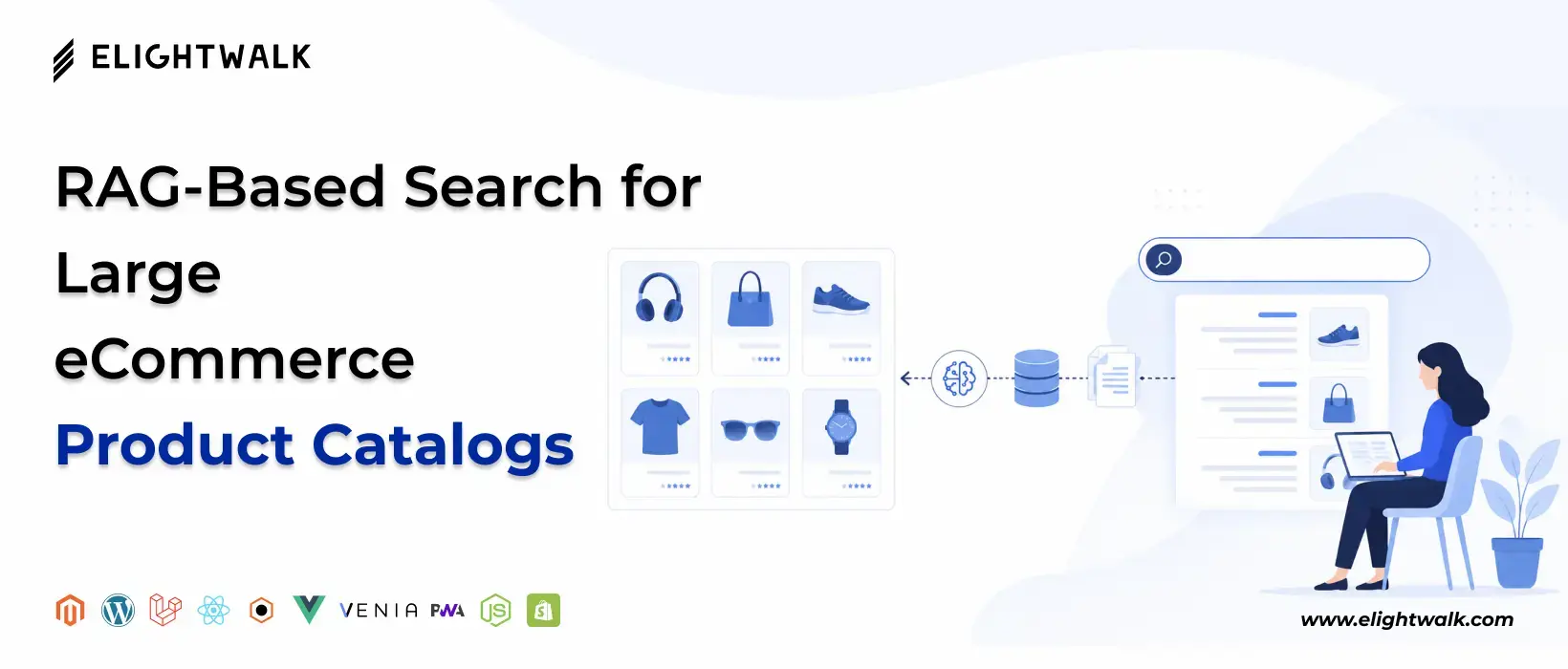
A Retrieval-Augmented Generation (RAG) system for eCommerce combines intelligent data retrieval with generative AI to deliver accurate, personalized, and context-aware shopping experiences. By retrieving relevant business information before generating responses, RAG enables online stores to provide better product discovery, customer support, and personalized recommendations. The architecture of a RAG system typically consists of three core components: data sources, the retrieval layer, and the generation layer.
Data Sources
The foundation of a RAG system begins with collecting and organizing data from multiple business sources. These data sources provide the contextual knowledge required for accurate retrieval and response generation.
Product Catalogs
Product catalogs contain essential information such as product titles, descriptions, specifications, categories, pricing, attributes, and images. This data enables the system to deliver accurate product search results and personalized recommendations.
Customer Reviews
Customer reviews provide valuable insights into product quality, user preferences, and customer sentiment. By leveraging review data, the system can improve recommendation quality and generate more informative conversational responses.
FAQs
Frequently Asked Questions (FAQs) contain information about products, shipping, returns, payments, warranties, and customer support policies. RAG systems use this knowledge to answer customer queries quickly and accurately.
Inventory Data
Inventory data includes stock availability, pricing updates, warehouse information, and fulfillment details. Real-time synchronization of inventory information ensures customers receive accurate and up-to-date product availability data.
User Behavior Data
User behavior data includes browsing history, search activity, clicks, wishlists, cart interactions, and purchase history. This information helps the system understand customer preferences and deliver highly personalized shopping experiences.
Retrieval Layer
The retrieval layer is responsible for identifying and retrieving the most relevant information in response to customer queries. This layer forms the intelligence backbone of the RAG architecture.
Embeddings Generation
Product information, customer reviews, FAQs, and user queries are converted into vector embeddings using AI embedding models. These embeddings represent the meaning and contextual relationships of the data in numerical form, making semantic search possible.
Vector Indexing
The generated embeddings are stored and organized within vector databases such as Pinecone, Weaviate, Milvus, or Elasticsearch with vector search capabilities. Vector indexing enables fast and efficient retrieval across large product catalogs and datasets.
Semantic Matching
When a customer submits a query, the system converts it into an embedding and compares it with stored embeddings in the vector database. Rather than relying on exact keyword matches, semantic matching identifies products and information based on meaning, context, and customer intent.
Generation Layer
The generation layer uses Large Language Models (LLMs) to create natural, conversational, and context-aware responses using the information retrieved from the retrieval layer.
LLM-Powered Responses
The AI model combines retrieved product information, customer data, and business knowledge to generate accurate and human-like responses for product searches, shopping assistance, and customer support interactions.
Dynamic Product Recommendations
Using customer intent, browsing behavior, purchase history, and retrieved contextual information, the system can recommend personalized products, suitable alternatives, and complementary items in real time.
Context-Aware Answers
By leveraging customer preferences, previous interactions, and current shopping behavior, the system generates highly contextual responses tailored to individual users. This enables more personalized product discovery, smarter customer support, and a more engaging shopping experience.
Together, these three layers create a powerful AI-driven eCommerce architecture that improves product search accuracy, enables conversational shopping experiences, delivers personalized recommendations, and enhances overall customer satisfaction across large and complex online stores.