Loading...

What is the Rapid Application Development Model

12 Mins
Pravin Prajapati  ·   10 Dec 2025
Illustration explaining the Rapid Application Development (RAD) model and its iterative, user-driven software engineering process
service-banner

Software teams are constantly required to improve the quality of their applications, and at the same time, they must do it faster. Businesses no longer have the luxury of long development cycles or year-long release timelines. Customer expectations evolve rapidly, market conditions can shift overnight, and technology trends change faster than traditional development models can adapt. As a result, faster software development cycles have become a strategic priority for organizations of all sizes.

Modern engineering teams must build, test, and deploy applications at high speed while maintaining functionality, security, and user experience. Traditional, documentation-heavy methodologies often fall short because they rely on strict planning and sequential phases. These rigid approaches make it difficult to adjust to evolving requirements, often leading to costly delays and missed opportunities.

This urgent need for speed and adaptability has led to the rise of Rapid Application Development (RAD). RAD emphasizes iterative development, continuous user feedback, and rapid prototyping, enabling teams to deliver working software much more quickly. By simplifying and accelerating the development lifecycle, RAD empowers organizations to meet user needs, respond to market demands, and comply with regulatory requirements with greater efficiency.

The relevance of RAD is particularly significant in FinTech, startups, and other fast-moving industries where time-to-market is critical. FinTech companies must continually adapt to evolving compliance rules, changing customer behaviors, and emerging technologies like blockchain and AI. Similarly, startups depend on agility—they must launch MVPs quickly, validate ideas, gather real user feedback, and iterate at a rapid pace to stay competitive.

What Is the RAD Model in Software Engineering?

The Rapid Application Development (RAD) model is a software engineering methodology designed to accelerate development through continuous user feedback, rapid prototyping, and iterative releases. Rather than spending extensive time on upfront planning and documentation, the RAD model prioritizes quickly building functional prototypes that users can interact with early in the development cycle.

The RAD model emphasizes three core principles: speed, flexibility, and user involvement. Requirements refinement, feature adjustments, and usability enhancements are performed collaboratively by developers and stakeholders, even while the product is still being built. This iterative process allows teams to identify issues early, make rapid improvements, and deliver functional applications much sooner than traditional development models allow.

The primary purpose of RAD is to accelerate software delivery. It accomplishes this by reducing dependency on rigid planning phases and shifting focus toward continuous prototyping and iterative improvements. By dividing the project into smaller modules and validating each through frequent user feedback, teams ensure that the final product aligns closely with real business needs.

This methodology represents a significant departure from traditional, plan-driven SDLC models such as the Waterfall approach. In Waterfall, stages like requirements, design, development, testing, and deployment occur sequentially, with little room for changes once a phase is completed. Modifying requirements later in the process is both costly and complex. RAD, in contrast, embraces change. Requirements can evolve continuously, prototypes can be updated immediately, and users remain engaged at every stage, resulting in a more adaptive and responsive development cycle.

Key Principles Behind Rapid Application Development

The Rapid Application Development (RAD) model is built around core principles that support fast software delivery without compromising quality or adaptability. These principles guide the RAD approach and distinguish it from traditional, linear development methodologies.

1. Iterative Development

RAD relies heavily on iterative development, where the application is built in small, manageable cycles rather than a single sequential process. Each iteration produces a working prototype that is tested, reviewed, and improved. This allows teams to respond quickly to changing requirements, address issues early, and continuously refine features.

2. Continuous User Involvement

A defining feature of RAD is continuous user involvement across the entire development lifecycle. End users actively participate by reviewing prototypes, validating functionality, and influencing design decisions in real time. This minimizes misunderstandings, reduces rework, and ensures the final product aligns closely with actual business needs.

3. Component-Based Construction

RAD encourages the use of reusable components, pre-built modules, and standardized elements to accelerate development. Instead of writing every component from scratch, teams assemble applications from existing building blocks. This modular approach increases consistency, reduces coding effort, and speeds up delivery.

4. Time-Boxing and Fast Delivery

Time-boxing is crucial in RAD. Each cycle whether planning, prototyping, or testing is constrained by a fixed timeframe. These strict deadlines prevent scope creep, promote rapid iterations, and ensure steady progress toward a working solution.

5. Visual Modeling and Automated Tools

RAD extensively uses visual tools such as GUI builders, drag-and-drop interfaces, workflow visualizers, and automated code-generation platforms. These tools simplify complex tasks, enhance prototyping efficiency, and help teams quickly create interactive models. Automated testing, deployment, and integration tools further improve development speed and accuracy.

The Four Phases of the Rapid Application Development Model

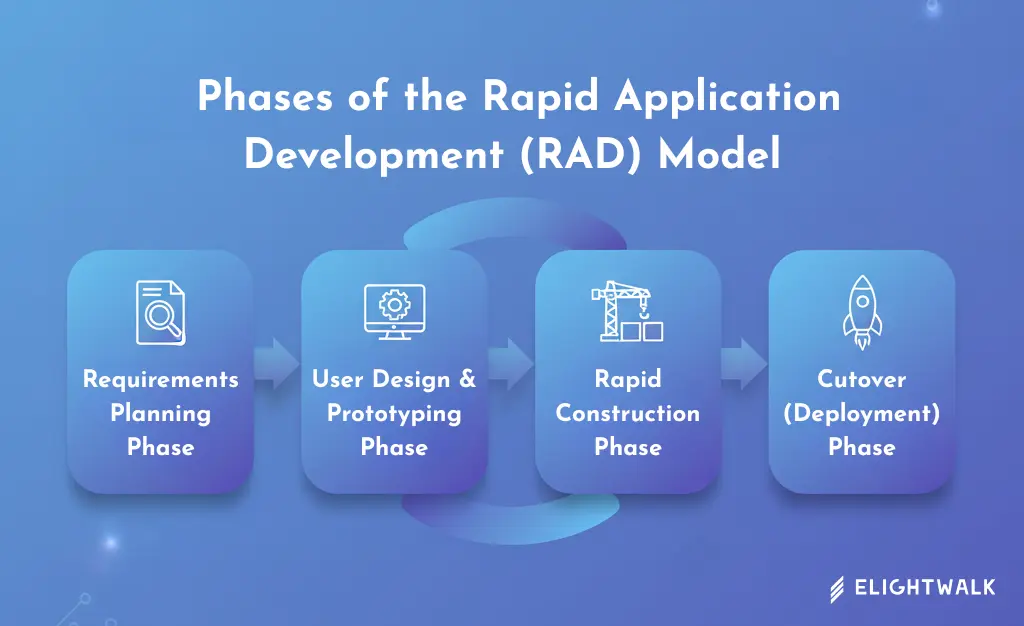
The Rapid Application Development (RAD) model divides the software lifecycle into four key phases: requirements, design, implementation, and testing. Each phase is built to support accelerated delivery, iterative refinement, and continuous user involvement. Together, these phases enable teams to develop high-quality applications far faster than traditional methodologies.

The Four Phases of the Rapid Application Development Model

Requirements Planning Phase

The Requirements Planning Phase establishes the foundation of the RAD model. Instead of lengthy documentation and exhaustive analysis, this phase focuses on identifying:

  • Core business needs
  • High-level project goals
  • Potential risks
  • System constraints

Rather than defining every requirement upfront, stakeholders and teams collaborate to build a shared understanding of the project direction. This ensures alignment while maintaining flexibility for changes that naturally arise during prototyping and development. The emphasis is on strategic clarity rather than detailed specifications.

User Design & Prototyping Phase

This is the most collaborative and interactive stage in the RAD lifecycle. Developers and end users work closely through:

  • Workshops
  • Prototype demonstrations
  • Continuous feedback loops

Teams create UI/UX prototypes, workflow models, and functional mockups, refining them based on real user input. Rapid iteration enables users to visualize features early, validate assumptions, and adjust requirements. This significantly lowers the risk of misunderstandings and ensures the final application aligns with actual user expectations.

Rapid Construction Phase

After prototypes are validated, the project enters the Rapid Construction Phase. Developers begin building the actual system using:

  • Reusable components
  • Automated tools
  • Visual builders and accelerators

Since much of the design and functionality has already been shaped during prototyping, developers can work quickly and efficiently. Functional builds are delivered in short cycles, allowing continuous stakeholder validation. This leads to faster development, fewer defects, and strong alignment with business requirements.

Cutover (Deployment) Phase

The final phase focuses on preparing and deploying the application into production. This includes:

  • Final testing and quality assurance
  • Data migration and system integration
  • Environment configuration
  • User training and onboarding
  • Performance optimization

Because the system has already been validated and refined through multiple iterations, deployment is typically smoother and faster compared to traditional SDLC models. The result is a high-quality, user-approved product delivered with minimal delay.

Advantages of the Rapid Application Development (RAD) Model

The Rapid Application Development (RAD) model provides several strong advantages, making it one of the most effective methodologies for fast, flexible, and user-driven software delivery. Its emphasis on iterative prototyping and continuous feedback makes it ideal for dynamic environments where requirements evolve quickly.

1. Faster Time-to-Market

One of the greatest strengths of RAD is its ability to dramatically reduce development timelines. By prioritizing rapid prototyping, reusable components, and parallel workflows, teams can deliver functional applications in weeks instead of months. This accelerated delivery offers organizations a significant competitive edge, especially in fast-moving industries.

2. High Customer and Stakeholder Satisfaction

RAD promotes continuous collaboration with end users and stakeholders. Frequent reviews, feedback sessions, and prototype interactions ensure that users can shape the system throughout development. This results in software that closely aligns with real business needs, improving user satisfaction and stakeholder confidence.

3. Flexibility to Change Requirements Mid-Project

Unlike traditional SDLC approaches, RAD welcomes requirement changes at any stage. As users test prototypes and discover new needs, the development team can adapt quickly. Continuous refinement allows adjustments without major delays or cost increases, making RAD ideal for industries with rapidly evolving demands or regulatory complexities.

4. Lower Development Risk Through Constant Validation

RAD minimizes risks by enabling early and ongoing validation. Each prototype functions as a usable version of the application, allowing teams to detect issues, refine features, and correct design flaws long before full-scale development. This iterative validation significantly reduces the likelihood of major setbacks late in the project.

5. Cost-Effective for Small and Medium-Size Applications

By leveraging reusable modules, automated tools, and reduced documentation, RAD often requires fewer development resources than traditional models. This makes it particularly cost-effective for small to medium-sized projects where agility and speed are more valuable than detailed upfront planning. Organizations benefit from shorter cycles, optimized budgets, and high-quality outcomes.

Limitations of Rapid Application Development

The Rapid Application Development (RAD) methodology offers exceptional speed and adaptability, but it comes with limitations that teams must consider before adoption. Its effectiveness depends heavily on factors such as project size, stakeholder engagement, and architectural requirements. While RAD accelerates delivery, it may not fit all project types or environments.

1. Requires Active User Involvement

RAD relies heavily on continuous user participation. End users and stakeholders must actively provide feedback, validate prototypes, and collaborate throughout the development cycle. Without this involvement, iterations lose value, requirements become unclear, and key features may remain unaddressed. If users are unavailable or unwilling to participate, RAD's core advantages are greatly diminished.

2. Best Suited for Smaller, Modular Applications

RAD delivers exceptional efficiency when projects can be divided into small, independent modules. It works best for lightweight applications or systems with clearly defined functionalities. As the project scope grows, it becomes increasingly difficult to break down the system into manageable modules, reducing RAD’s overall effectiveness and benefits.

3. May Compromise Architecture Consistency

Because RAD prioritizes speed and rapid iterations, architectural consistency may suffer. Frequent changes and quick prototypes can introduce inconsistencies in design, coding standards, and system structure. Without strong technical oversight, teams risk accumulating technical debt and delivering a product with an unstable or inefficient architecture.

4. Not Ideal for Highly Complex or Large-Scale Systems

RAD is not well-suited for enterprise-level, mission-critical, or highly regulated systems that require robust documentation, detailed upfront planning, and a stable architecture. These systems depend on careful long-term planning and strict compliance—not the fast-paced, flexible nature of RAD. As a result, RAD is less effective for large-scale projects with deep integrations and stringent reliability requirements.

When Should You Use the RAD Model?

The RAD methodology is ideal for business scenarios where software must be flexible, efficient, and delivered quickly. Because RAD depends on continuous prototyping, user feedback, and short development cycles, it is particularly effective under the following conditions.

Projects with Evolving or Unclear Requirements

Many modern software projects begin without fully defined requirements. As business conditions and priorities shift rapidly, RAD is an excellent fit for such dynamic environments.

Why RAD Fits These Projects:

  • Early prototypes help stakeholders refine requirements based on real interactions.
  • Teams can adjust scope and features continually instead of following a rigid plan.
  • The iterative approach keeps the project aligned with changing business goals.

Example Scenarios:

  • A startup shaping its product direction through early user research.
  • Organizations adapting to new compliance or regulatory rules in FinTech, healthcare, or insurance.
  • Companies automating internal processes where workflows evolve frequently.

In these cases, RAD reduces risk and ensures the end product matches current needs.

MVP Development or Proof-of-Concept Projects

RAD is exceptionally effective for MVPs and PoCs, where rapid validation matters more than extensive planning.

Why RAD Works Well Here:

  • Prototypes are built in days or weeks, enabling early user testing.
  • Stakeholders can validate ideas before committing major resources.
  • Teams can pivot quickly if feedback reveals new requirements.

Example Scenarios:

  • A FinTech prototype for instant loan approval.
  • A lightweight mobile app to measure user interest.
  • A feature demo for investors.

RAD supports rapid idea validation and agile decision-making.

Internal Business Automation Tools

Internal tools, dashboards, workflows, and automation systems benefit greatly from RAD’s speed and collaborative nature.

Why RAD Excels in Internal Projects:

  • Internal users are readily available for frequent feedback.
  • Processes are well understood, but UI/UX evolves often.
  • Reusable components allow quick updates and enhancements.
  • Time-boxing ensures regular releases and improved operational efficiency.

Examples:

  • HR automation platforms
  • Procurement and expense approval workflows
  • Internal CRM dashboards
  • Employee onboarding systems

Speed and adaptability make RAD an excellent match for internal applications.

Web Apps, Mobile Apps, and Rapid Workflow Applications

Digital applications benefit greatly from RAD’s fast iteration and design flexibility—especially when user behavior changes frequently.

Why RAD Suits These Applications:

  • Visual modeling enables continuous UI/UX refinement.
  • Features can be released incrementally for web and mobile environments.
  • Teams can quickly respond to evolving user needs.
  • Modular design enables easy integration with APIs and reusable UI components.

Example Scenarios:

  • Developing a mobile banking app with frequently updated features.
  • Creating a web-based customer onboarding platform.
  • Building workflow automation tools for internal operations.
  • Designing customer-facing portals with regular updates.

RAD’s speed and adaptability align well with the rapid evolution of modern digital ecosystems.

When You Should Use the RAD Model

  • You need rapid development rather than heavy documentation.
  • Requirements are unclear, evolving, or expected to change frequently.
  • Stakeholder collaboration is accessible and consistent.
  • The project can be broken into modular parts.
  • You’re building MVPs, PoCs, or internal tools.
  • You’re developing web, mobile, or workflow-driven applications requiring frequent UI/UX improvements.

When applied under the right conditions, RAD significantly enhances development efficiency, improves user satisfaction, and ensures strong alignment between the final product and business objectives.

Popular Rapid Application Development Tools in 2026

As software development evolves, the demand for faster delivery, efficient collaboration, and simplified engineering processes has accelerated the adoption of cutting-edge Rapid Application Development (RAD) tools. In 2026, these tools blend automation, visual modeling, and component-based design to help teams build applications rapidly without sacrificing quality. Below are the major categories of RAD tools widely used today.

Low-Code and No-Code Platforms

Low-code and no-code platforms have become central to modern RAD practices. These tools enable developers and in some cases, non-technical users to create fully functional applications through visual interfaces instead of manual coding.

Why They’re Important in RAD:

  • Reduce development time by eliminating repetitive coding tasks.
  • Enable rapid prototyping and fast iteration cycles.
  • Support drag-and-drop components, prebuilt templates, and automated workflows.
  • Allow business users to collaborate directly with developers.
  • Lower the barrier to entry for small teams or organizations with limited technical resources.

Common Uses:

  • Internal business applications
  • Forms, approval workflows, dashboards
  • Customer-facing web and mobile apps
  • MVPs and proofs of concept

Workflow Builders and Prototyping Tools

Workflow builders and prototyping tools help teams visualize processes, design user journeys, and create interactive prototypes before development begins. These tools align perfectly with RAD’s principle of early validation.

Why They Matter:

  • Enable real-time collaboration among designers, developers, and stakeholders.
  • Allow quick creation of interactive prototypes for testing and validation.
  • Help teams illustrate complex workflows clearly.
  • Reduce miscommunication by visually demonstrating system behavior before coding.

Common Uses:

  • UI/UX prototypes
  • Business process workflow diagrams
  • User journey and navigation mapping
  • Functional prototypes for stakeholder demos

Database Modeling and UI Visualization Tools

Data and interface design are critical components of software development. RAD tools focused on database modeling and UI visualization accelerate both by enabling teams to design structures and layouts visually.

Why They’re Valuable:

  • Visual database modeling minimizes errors and ensures consistency.
  • Automated schema generation reduces manual coding effort.
  • UI visualization tools allow drag-and-drop layout creation.
  • Data models can be mapped directly to user interfaces for faster iteration.

Common Uses:

  • Designing ER diagrams and database models
  • Creating forms, dashboards, and UI layouts visually
  • Integrating backend data structures with frontend prototypes
  • Simplifying workflows for developers and analysts

Drag-and-Drop App Builders, Workflow Automation Platforms, and Code-Generation Tools

These tools form the backbone of many modern RAD environments, helping teams assemble applications quickly using predefined modules or auto-generated code.

The Reason They Facilitate Rapid Development:

  • Automate repetitive development tasks, saving significant time.
  • Enable rapid creation of functional components and system features.
  • Support seamless API integration, authentication, and external service connectivity.
  • Simplify deployment through built-in pipelines or cloud hosting options.

Examples (Generic):

  • Drag-and-drop app builders for assembling pages, forms, dashboards, and mobile screens.
  • Workflow automation platforms for approvals, notifications, and multi-step business processes.
  • Code-generation tools that convert diagrams into usable backend and frontend code.

RAD tools emphasize speed, automation, visual design, and user collaboration qualities that make them ideal for building business workflows, mobile apps, prototypes, or MVPs. By leveraging these tools, teams can deliver high-quality software in a fraction of the time required by traditional development models.

Rapid Application Development for FinTech

The FinTech industry is advancing at remarkable speed, driven by innovations in digital payments, regulatory technology, online lending, automation, and mobile banking. In this fast-paced environment, companies must innovate rapidly while ensuring accuracy, compliance, and security. The Rapid Application Development (RAD) model has become a powerful approach for FinTech teams seeking to deliver high-quality applications quickly without compromising user experience or regulatory requirements.

Why FinTech Needs RAD

FinTech products operate in extremely dynamic conditions, where customer expectations, market trends, and regulatory frameworks evolve constantly. RAD supports this environment through rapid development, continuous stakeholder collaboration, and iterative refinement.

1. Faster Product Innovation

Digital wallets, payment gateways, lending portals, and KYC dashboards require constant updates. RAD enables teams to quickly develop new features, gather real-user feedback, and iterate in short cycles. This agility keeps FinTech companies ahead of competitors and aligned with market trends.

2. Changing Regulatory and Compliance Requirements

FinTech platforms must meet strict and evolving regulations such as KYC, AML, PCI-DSS, GDPR, and regional compliance standards. RAD’s iterative process allows teams to update workflows, forms, and validation logic quickly without slowing down development, ensuring continuous compliance.

3. Need for Quick User Feedback Cycles

Users expect seamless onboarding, instant transactions, and intuitive digital experiences. RAD provides early-stage prototypes for user testing, enabling teams to address usability issues quickly, improve UX, and boost adoption rates.

4. Frequent Feature Updates Driven by Competition

FinTech companies regularly roll out features such as biometric login, instant transfers, AI-driven insights, and automated savings tools. RAD supports fast implementation of these updates, helping companies maintain a competitive edge and respond to customer demands rapidly.

How RAD Improves FinTech Development

Beyond speed, RAD enhances flexibility, user experience, and long-term maintainability—key attributes of successful financial software.

1. Rapid Prototyping for User-Centric Banking Apps

Interactive prototypes of banking interfaces, transaction flows, dashboards, and onboarding forms allow stakeholders to visualize the product early. This leads to better design decisions, reduced rework, and products that truly align with user expectations.

2. Modular Development for Payment Gateways, Wallets, and Dashboards

FinTech systems are naturally modular—authentication, payments, fraud detection, account management, and reporting. RAD leverages component-based development, enabling teams to reuse modules, integrate them easily, and update features independently.

3. Reduced Time to Launch New Digital Financial Products

For micro-lending platforms, BNPL services, neobank features, or investment apps, RAD drastically shortens time-to-market. By focusing on prototypes instead of heavy documentation, teams can validate assumptions early and release new financial products faster.

4. Faster Turnaround for Bug Fixes and Security Updates

Security and compliance are essential in FinTech. RAD’s iterative cycles allow early issue detection and rapid updates, helping teams patch vulnerabilities, optimize workflows, and stabilize systems without long release delays.

Use Cases of RAD in FinTech

RAD’s iterative model, modular architecture, and user-driven focus make it ideal for a variety of FinTech applications.

1. Loan Origination Platforms

Loan workflows—including application submission, identity verification, credit scoring, underwriting, and approval—benefit from RAD’s rapid prototyping. Teams can validate each step with users and compliance officers, ensuring accuracy and regulatory alignment.

2. Mobile Banking Apps

Mobile banking requires flawless UX, real-time performance, and ongoing feature updates. RAD supports rapid UI/UX design, incorporation of user-requested features, and quick delivery of improvements such as budgeting tools, insights, and secure authentication methods.

3. Fraud Detection Dashboards

Fraud detection systems need dynamic dashboards, anomaly alerts, and real-time risk scoring. RAD enables fast prototyping of dashboards, incorporation of feedback from analysts, and integration of machine learning models for enhanced monitoring.

4. Automated KYC/AML Workflows

KYC and AML processes change frequently due to compliance updates. RAD allows rapid development of identity verification, document scanning, risk profiling, audit trails, and rule-based workflows—ensuring minimal disruption to existing systems.

RAD’s speed, flexibility, and collaborative approach make it one of the most effective development methodologies for FinTech innovations. It enables companies to deliver secure, compliant, high-performance financial products at a pace that matches today's fast-moving digital economy.

RAD Model vs Agile: Are They the Same?

The Rapid Application Development (RAD) model and Agile methodology are often compared due to their shared focus on flexibility, collaboration, and iterative progress. However, they are fundamentally different in philosophy, workflow structure, and ideal use cases. The comparison below highlights the primary distinctions.

Criteria RAD Model Agile Methodology
Development Focus Rapid prototyping, visual models, quick iterations Incremental development through structured sprints
Planning & Documentation Minimal upfront planning; light documentation Moderate planning with backlog, sprint planning, and documentation
User Involvement Very high; continuous hands-on feedback via prototypes Regular but structured involvement through sprint reviews
Team Structure Small, skilled teams using specialized tools Cross-functional teams with defined roles like Scrum Master & Product Owner
Ideal Project Size Small to medium projects with changing requirements Large or long-term projects requiring continuous development
Tool Dependency Heavy use of low-code/no-code tools and visual builders Relies more on manual development within sprint cycles
Speed of Delivery Extremely fast; time-boxed delivery cycles Fast but structured; dependent on sprint duration
Best Use Purpose Quick prototypes, MVPs, internal tools Long-term product evolution and continuous improvement

When to Use RAD vs Agile

Use RAD if:

  • You need a functional prototype in weeks, not months.
  • Requirements are unclear or expected to evolve continuously.
  • Stakeholders can provide ongoing feedback through direct involvement.
  • The project can be broken into modular components.
  • You are developing MVPs, POCs, or internal business applications.
  • A small, highly skilled team is available for rapid iteration.

Use Agile if:

  • The product is long-term and requires scalability.
  • A structured, sprint-based workflow is needed.
  • Large team collaboration with defined roles is required.
  • Predictable delivery cycles matter for planning.
  • Requirements change but are managed through a backlog.
  • Continuous enhancement is expected over months or years.

Overlap Between RAD and Agile

  • Both use iterative development rather than linear processes.
  • Both rely on frequent feedback to stay aligned with user needs.
  • Both improve collaboration among developers, designers, and stakeholders.
  • Both reduce project risk through early validation.
  • Both suit modern digital products that require fast updates and frequent releases.

In summary, Agile offers a structured framework for long-term product evolution, while RAD provides a focused approach for rapid prototyping and ultra-fast delivery—ideal when speed is the top priority.

Best Practices for Implementing RAD Successfully

Implementing RAD effectively requires the right combination of collaboration, tools, and disciplined execution. While RAD enables speed and adaptability, its success depends on how well teams manage stakeholder involvement, prototyping quality, scope flexibility, and architectural structure. The following best practices ensure efficient and high-quality outcomes.

1. Maintain Close Stakeholder Involvement

RAD depends heavily on the ongoing involvement of stakeholders, business teams, compliance officers, and end-users. Their continuous feedback ensures that prototypes evolve according to real business needs.

Why It Matters:

  • Prevents misunderstandings and feature misalignment
  • Enables early validation of requirements
  • Reduces late-stage rework and delays

Best Practices:

  • Schedule regular feedback and review sessions
  • Include users in prototype demonstrations
  • Use collaborative tools for real-time comments and approvals

2. Use Strong Prototyping Tools

Prototypes are the foundation of RAD. High-quality tools speed up iteration, improve communication, and reveal issues earlier in the development cycle.

Why It Matters:

  • Accelerates UI/UX validation
  • Helps stakeholders visualize workflows
  • Allows developers to detect design or logic issues early

Best Practices:

  • Select drag-and-drop or visual modeling tools
  • Choose platforms that integrate with backend services
  • Use tools capable of generating interactive, clickable prototypes

3. Keep Scope Flexible but Controlled

RAD promotes adaptability, but without proper control, scope creep can lead to delays and rework. Teams must strike a balance between flexibility and disciplined execution.

Why It Matters:

  • Prevents uncontrolled growth in features and requirements
  • Keeps development on track with timelines
  • Ensures the team focuses on delivering core business value

Best Practices:

  • Define essential, non-negotiable requirements early
  • Classify features as “must-have” and “nice-to-have”
  • Use time-boxing to guide iteration cycles

4. Use Modular Architecture for Easier Iteration

A modular technical architecture is essential in RAD. It allows teams to build, test, and modify components independently, accelerating development and reducing integration complexity.

Why It Matters:

  • Enables quick updates without disrupting the entire system
  • Improves reusability of components across modules
  • Reduces integration challenges during deployment

Best Practices:

  • Create reusable UI components, services, and APIs
  • Separate business logic from presentation layers
  • Adopt standards-based architecture for seamless integration

Essence

The Rapid Application Development (RAD) model remains a strong choice because it helps teams build software faster, adapt to changing requirements, and involve users throughout the entire software development cycle. By emphasizing quick prototypes, continuous feedback, and modular development, RAD reduces project risks, ensures product alignment with real business needs, and significantly shortens the time required to deliver functional solutions.

Also read: What is Adaptive Software Development​? A Guide with Comparison

RAD is particularly valuable in modern software engineering and FinTech environments, where regulatory frameworks evolve frequently, customer expectations shift rapidly, and speed-to-market is crucial. Its flexible, fast-paced methodology enables teams to launch high-quality digital products sooner while staying competitive in fast-moving markets.

FAQS about Rapid Application Development Model

What is the RAD model in software engineering?

What are the phases of the Rapid Application Development model?

Why is RAD useful for rapid app development?

Which tools are used in RAD development?

Is RAD suitable for FinTech applications?

Pravin Prajapati
Full Stack Developer

Expert in frontend and backend development, combining creativity with sharp technical knowledge. Passionate about keeping up with industry trends, he implements cutting-edge technologies, showcasing strong problem-solving skills and attention to detail in crafting innovative solutions.

Most Visited Blog

What is Adaptive Software Development​? A Guide with Comparison
Discover Adaptive Software Development (ASD), a flexible, iterative methodology that embraces change, fosters collaboration, and ensures continuous learning for modern software projects.
How to Build a Multi-Storefront Setup with MedusaJS
Learn how to build a multi-storefront setup with MedusaJS. Discover how this open-source, headless ecommerce engine enables global stores, multi-brand retail, and B2B/B2C hybrid strategies.
Professional Website Development for E-commerce Success
We build professional websites for e-commerce, mobile, and custom solutions. Fast, secure, and designed for growth.